 Camelotexchange
 liquidity pools and V3 fee income across price ranges
Updated onCamelotexchange liquidity pools include V3 positions that stop earning trading fees when the pool's market price moves outside their selected range. A return within that range allows fee generation to resume when swaps use the position's liquidity. Manual and automated management offer different ways to maintain range exposure.
A V3 position can hold assets without earning new trading fees when the market price lies outside its selected range.
Manual control or automated range adjustment
Manual mode gives you control over price bounds; auto mode uses a selected provider's strategy to adjust ranges. On Camelot, the Arbitrum-based exchange, both approaches sit within concentrated liquidity provision. A manual position needs its owner to assess whether its bounds still fit the intended exposure. Automatic adjustment doesn't establish continuous fee income, because earnings still require trading activity through active liquidity.
When does a V3 position stop earning trading fees?
A V3 position outside its selected price range doesn't earn trading fees. Liquidity remains in the position, but it no longer participates in swaps at that price. The position's token composition changes as trades move the price through its bounds. Outside the range, the holding becomes concentrated in one token. The relevant comparison uses the position's actual bounds and the pool's current price.
Fee generation can resume after the price re-enters the unchanged range and swaps use that position's liquidity.
Accrued fees and active status describe different things. A pending fee balance records income already generated. Its presence doesn't show that the position currently contributes liquidity at the market price. Reading an accumulated balance as a live earning rate can hide an inactive range.
The holding's value can still change while the position is out of range and earns no new trading fees. Those changes remain relevant even after the position becomes active again.
Can a single-asset deposit earn fees immediately?
A single-asset V3 position whose range excludes the current market price won't earn trading fees until that price enters the range. Manual mode allows one-sided liquidity above or below the current price, depending on the token supplied.
The deposit's starting composition won't necessarily match its composition at withdrawal. Swaps within the range change the balance between the pool tokens. A position funded with one token can therefore acquire the other token during trading. Its fee income and final token amounts reflect that activity, alongside the price path.
Creating a manual or managed position
The V3 manual and auto paths offer different control over future range adjustments. Compare the intended range exposure and the costs of managing it before choosing a mode. Transaction costs for later changes belong in that comparison, alongside the trading fees that the active position generates.
| Deposit stage | Manual mode | Auto mode | State reached |
|---|---|---|---|
| Select the pool and mode | Choose the pair and Manual mode | Choose the pair and Auto mode | Pool and management method selected |
| Set the deposit | Choose price bounds and enter token amounts | Select a provider and strategy, then enter amounts | Range or strategy and required token amounts specified |
| Authorize and create | Approve when required, review and confirm Add liquidity | Approve when required, review and confirm Create position | Position available for management after the liquidity transaction succeeds |
Compare the newly created position's pool and range or selected strategy with the settings reviewed before confirmation. A manual position with the intended bounds may still be inactive at the current price. An auto position follows the selected strategy, so its range can change afterward. Confirming those initial choices helps distinguish a configuration mistake from ordinary range movement before further liquidity is added.
Range width and the cost of keeping liquidity active
A narrower price interval concentrates the same deposited capital within a smaller span of prices. That can increase the liquidity contributed at prices inside the interval. With both bounds tightened around the current price, less price movement is needed for the position to go out of range. That trade-off prevents range width from acting as a simple ranking of expected income. The relevant inputs include how long the market stays within the bounds, actual swap activity and the costs of making adjustments. Manual management requires decisions about those changes. Auto mode uses the selected strategy to handle range adjustment, so its behavior belongs in the same assessment.
The two token amounts required for a deposit follow the range's position relative to the market price. Changing the bounds can change that ratio before any liquidity enters the pool.
V2 and V4 change the pool choice
V2 liquidity spans the full price range, while V3 and V4 positions can use selected price ranges. V2 supports volatile pairs through a constant-product curve and correlated pairs through a stable curve. That pool-type choice concerns how the paired assets trade against each other. A stable curve aims to keep exchanges near a one-to-one relationship for correlated assets; it doesn't guarantee either asset's market value. V3 instead concentrates liquidity within selected prices and uses Algebra V1.9.
V4 uses Algebra Integral 1.2 and retains concentrated liquidity while separating core liquidity storage from configurable pool functionality. Plugins can affect fees and other pool behavior. The AMM V4 documentation describes a beta stage for testing plugin configurations. Multiple custom pools can exist for the same token pair, with different settings. An identical pair name therefore doesn't establish an identical configuration across versions or pools. A V3 management choice shouldn't be assumed to describe a V4 custom pool.
Pool settings behind trading fee income
The trading fee that a pool charges is one input to liquidity provider income, alongside swap volume and active liquidity. V2 allows pool-specific fees and different settings for the two swap directions. V3 introduces volatility-sensitive fees and directional fee ranges. These mechanisms mean that the fee for one pool or direction doesn't establish the fee for every trade in the pair. A position also earns from the swaps that use its active liquidity. A quoted fee percentage therefore cannot establish a future cash amount without the relevant trading activity.
Camelot's V4 adaptive-fee plugin uses volatility over the preceding 24 hours. Its sliding-fee plugin responds to the last block's price change and swap direction. The sliding fee rises for a swap in the direction of that change and falls for the opposite direction. Custom pool deployers can also configure a plugin fee that gives them a share of swap fees. These settings describe distinct mechanisms. They shouldn't be merged into one fixed platform fee or read as the amount that a particular liquidity position will receive.
Campaign incentives and xGRAIL balances
Trading fees come from swaps, while campaign incentives come from funded reward distributions. The incentive-system documentation lists support for V2 and V3, with V4 support planned. An out-of-range position has no new trading fees to contribute to a fee-based V3 campaign calculation. V3 campaigns with token weighting also consider the position's holdings of the specified pool tokens, subject to their eligibility rules. An incentive balance doesn't show whether the position's liquidity is currently active.
GRAIL and xGRAIL can appear among campaign reward tokens. An xGRAIL balance isn't equivalent to transferable GRAIL, because xGRAIL is non-transferable by default, except from or to whitelisted addresses. Pool fee income, campaign allocations and token usability describe different parts of the position's proceeds.
Does removing liquidity return the original token amounts?
Removing V3 liquidity returns its remaining token amounts, so the original deposit quantities won't necessarily be restored. Pending fees and incentives need separate accounting from that token balance. A positive accumulated fee total doesn't establish whether the combined withdrawal value exceeds the initial deposit. That comparison also depends on the prices of the assets when their values are measured. Changes in token composition can leave the position's tokens worth less than the original deposit held outside the pool. This shortfall is impermanent loss; trading fees may not offset it.
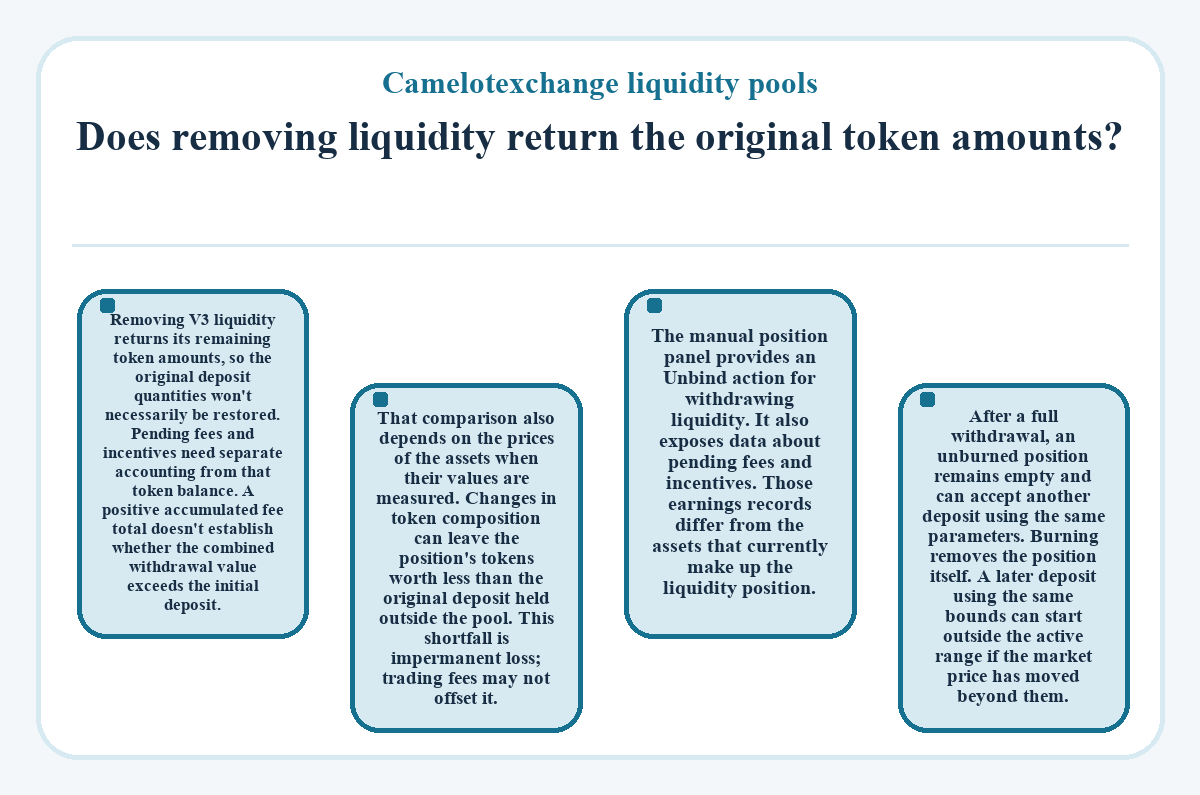
The manual position panel provides an Unbind action for withdrawing liquidity. It also exposes data about pending fees and incentives. Those earnings records differ from the assets that currently make up the liquidity position.
After a full withdrawal, an unburned position remains empty and can accept another deposit using the same parameters. Burning removes the position itself.
A later deposit using the same bounds can start outside the active range if the market price has moved beyond them.
Useful questions about Camelotexchange liquidity pools
Are V3 range prices stored exactly as I enter them?
V3 range prices are rounded to the nearest tick. Ticks form the price grid used for position bounds, so the effective limits can differ from the numbers typed into the manual controls. The position's resulting bounds govern whether its liquidity is active. Using a non-round input doesn't bypass tick rounding.
Where can I find a manual V3 position after depositing?
Manual V3 positions can be viewed through Earn, then Positions, then LP V3. The deposit flow also provides a View existing positions option after liquidity has been added successfully. The management panel includes controls for withdrawing liquidity and harvesting rewards, alongside position data and pending fees and incentives.
How do I increase liquidity in an existing manual V3 position?
Use Add in the V3 position management panel to increase liquidity in an existing position. Harvest collects pending rewards; Unbind withdraws liquidity. Increasing the deposited amount doesn't itself change the range condition for earning trading fees. The position still needs active liquidity used by swaps.
Can transfer-tax tokens charge a tax when I add liquidity?
A transfer-tax token can charge a tax on a liquidity deposit if its token rules apply that tax to adding liquidity. A token's transfer tax and the fee charged on swaps are separate mechanisms. A tax on token swaps doesn't, by itself, establish that the same tax applies to liquidity provision.
Is a full-range V3 deposit available in manual mode?
Manual V3 mode includes a Full range option for liquidity across the full price range, as in V2. This changes the position's chosen bounds without turning it into a V2 pool. Full-range provision spreads capital across more prices than a concentrated interval. The setting alone doesn't establish the amount of fees that the position will earn.