 Camelotexchange
: swaps, liquidity and the Arbitrum ecosystem
Updated onCamelotexchange, known as Camelot, is a decentralized exchange for token swaps and liquidity provision in the Arbitrum ecosystem. Liquidity pools supply the tokens that traders exchange. Its wider system includes several automated market maker (AMM) versions, GRAIL and xGRAIL, with infrastructure extending from Arbitrum One into Orbit chains.
The short version: A Camelot swap's route depends on its selected mode, and transfer-tax tokens need additional handling before execution.
Swap routing across V2 and V3
In the V2/V3 swap interface, the selected mode determines which AMMs and aggregator APIs are available for routing. Aggregator (V3) combines the ParaSwap and OpenOcean APIs with Camelot's V2 and V3 AMMs. Its quote depends on the routes and liquidity available for the selected trade.
The Native option uses only Camelot's V2 and V3 AMMs.
Choosing V3 restricts the swap to the V3 AMM, while choosing V2 restricts it to V2. Those choices matter when the available liquidity or token behavior calls for a particular version. The quoted rate and output belong to the selected route and token amount.
Pool versions change liquidity behavior
The AMM version changes how a pool organizes liquidity and which fee or plugin controls can affect a trade.
| AMM version | Liquidity design | Configuration affecting trades |
|---|---|---|
| V2 | Stable or volatile pools | Dynamic directional fees |
| V3 | Concentrated price ranges | Volatility-sensitive directional fees |
| V4 | Concentrated liquidity with modular architecture | Pool-specific plugins and fee logic |
V2 stable and volatile curves
V2 uses different curves for volatile and stable pairs: volatile pairs use the constant-product relationship between pool balances. Stable pairs use a curve intended for correlated assets. A stable-pool design targets efficient exchange between correlated tokens; it doesn't guarantee that either asset will maintain a fixed value.
V3 concentrated liquidity
V3 places liquidity within selected price ranges using an implementation based on Algebra V1.9. Tick spacing controls how price boundaries can be set, and pool fees can respond to volatility. The range that a provider chooses determines where that liquidity participates in trades.
V4 pool plugins
V4 integrates Algebra Integral 1.2 and separates core liquidity storage from peripheral logic. Pool plugins can supply features such as fee logic and specialized incentives. That modularity allows non-core functionality to change without migrating the core liquidity system. V4 also supports distributing accrued rebasing tokens to liquidity providers.
The documented V4 beta plugin setup includes emergency controls that can halt a specific pool or all pools. Emergency halt controls depend on the deployed plugin configuration.
Liquidity provision and range upkeep
Liquidity providers add tokens to smart-contract pools and receive a share of trading fees under the applicable pool rules. Additional incentives depend on an active program and the position's eligibility. Trading fees accrue from swaps, while campaign rewards follow the program's allocation rules. With concentrated liquidity, the market price can move beyond a position's selected range. In V3 manual mode, an out-of-range position stops earning trading fees until the price returns to that range. Its asset composition also shifts toward one side of the pair. Ongoing management involves monitoring range status as well as accrued fees.
Manual and automatic management offer different ways to maintain those ranges. Manual mode lets the provider set price boundaries. Auto mode uses a selected strategy to adjust ranges, adding a strategy choice to the deposit. Automation changes how ranges are maintained; the deposited tokens remain exposed to market movements.
Changes in relative token prices can leave a liquidity position worth less than simply holding the deposited assets. That shortfall is known as impermanent loss. Trading fees may offset some or all of it, so fee income and changes in token composition both matter when assessing the position.
GRAIL and xGRAIL within the protocol
GRAIL is Camelot's native token; xGRAIL is an escrowed governance token corresponding to staked GRAIL. Its transfers require a whitelisted sender or recipient. Farming and direct GRAIL conversion can provide xGRAIL. Allocation involves staking xGRAIL in its token contract and assigning the deposited amount to a plugin. For example, the Real Yield Staking plugin distributes protocol earnings according to each user's share of xGRAIL allocated to it. Benefits depend on the selected plugin's rules. These token-allocation plugins have a different role from V4's pool plugins, which configure how a liquidity pool behaves.
What does the Orbital Liquidity Network add?
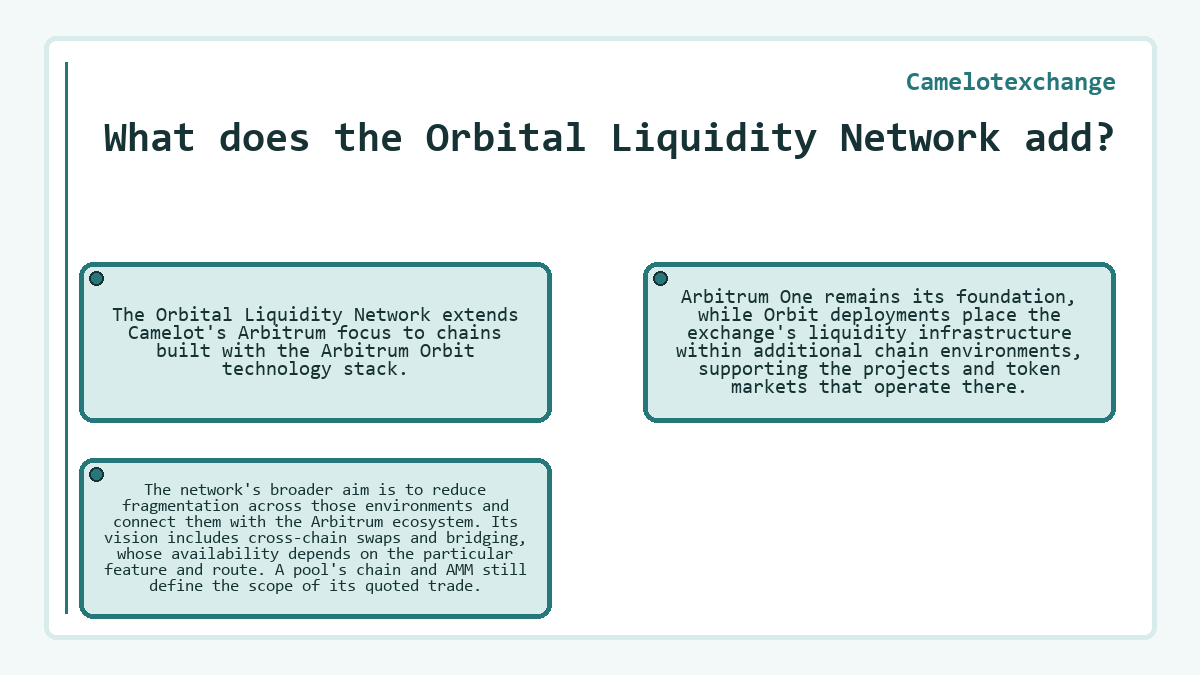
The Orbital Liquidity Network extends Camelot's Arbitrum focus to chains built with the Arbitrum Orbit technology stack. Arbitrum One remains its foundation, while Orbit deployments place the exchange's liquidity infrastructure within additional chain environments, supporting the projects and token markets that operate there. The network's broader aim is to reduce fragmentation across those environments and connect them with the Arbitrum ecosystem. Its vision includes cross-chain swaps and bridging, whose availability depends on the particular feature and route. A pool's chain and AMM still define the scope of its quoted trade.
Quoted output and transfer-tax exceptions
If a token charges transfer tax, routing and slippage settings must account for the extra deduction before the swap.
Rate, price impact and minimum output
Swaps carry a trading fee, and the applicable pool can use dynamic fee logic. Price impact measures how the trade affects the pool's price. Minimum received is the output floor attached to the swap settings. Slippage tolerance allows a specified degree of movement from the quote; increasing it permits a less favorable execution.
Swap confirmation is distinct from any required token approval, which grants the selected contract permission to use that token. Review the output terms before confirming the swap, including any change that follows a different mode or amount.
Transfer-tax tokens
A token's transfer tax is separate from the pool's trading fee. The charge can apply to purchases, sales or transfers, depending on that token's rules. Some tokens also tax liquidity additions. Its effect needs to be included when assessing output and the tolerance that the trade requires.
V2 is commonly required for tax tokens, although V3 can apply when the token's liquidity is there. Use the direct mode that matches the available liquidity. Aggregator routing can apply a token's transfer tax more than once during a swap. Avoid aggregator mode for these tokens. Raising slippage tolerance permits more output variation; it doesn't remove the tax.
Camelotexchange: what people ask
-
Can a slippage error confirm that a token has a transfer tax?
- A slippage error alone can't confirm a transfer tax. An error about an invalid estimated amount can also occur during high price volatility. Whether tax applies depends on the token's charging rules.
-
Why can buying and selling through the same V3 pool carry different fees?
- A V3 pool can use separate volatility-based fee ranges for the two trade directions. Its fee settings can therefore produce different charges when the direction changes, even within the same pool. Volatility-sensitive fees also respond to market conditions, so one quoted charge doesn't establish a permanent rate.
-
How many GRAIL tokens can exist?
- GRAIL has a maximum supply of 100,000 tokens. Circulating supply and the amount available for trading in any pool are separate quantities.
-
Does V4 allow multiple pools for the same token pair?
- V4 supports multiple pools for one token pair, including default pools and custom pools created by users or protocols. Each custom pool can have its own fee structure and plugins. The token pair alone therefore doesn't identify how every associated pool behaves.
-
Are liquidity incentives open to every address?
- A V2 or V3 incentive campaign can limit eligible addresses through whitelist or blacklist settings. A whitelist includes selected addresses; a blacklist excludes selected addresses. Providing liquidity to an incentivized pair therefore doesn't override that campaign's address restrictions.